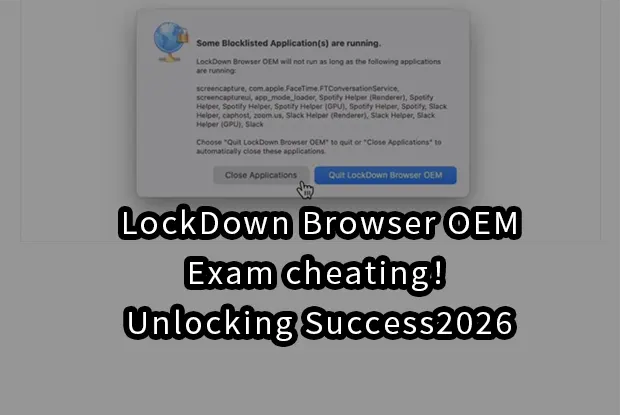
Introduction to LockDown Browser OEM Exams: A Technical Overview,In the evolving landscape of online education, LockDown Browser OEM exams represent a sophisticated fusion of security protocols and assessment delivery. LockDown Browser, developed by Respondus, is a custom browser designed to create a controlled environment for online testing. The “OEM” variant—standing for Original Equipment Manufacturer—refers to its tailored integration with specific platforms like Pearson MyLab, Cadmus, or other learning management systems (LMS). This version ensures seamless compatibility while enforcing stringent restrictions to maintain exam integrity.
At its core, LockDown Browser OEM operates by overriding standard browser functionalities. When launched, it disables access to external applications, prevents printing, blocks screen captures, and restricts navigation to unauthorized websites. For instance, during an exam on Pearson MyLab, students must download the OEM-specific installer, which then hijacks the system’s default browser session. This creates a sandboxed environment where only the exam interface is accessible, monitored through kernel-level hooks that intercept system calls.
Understanding these mechanics is crucial for anyone navigating high-stakes assessments. LockDown Browser OEM exams are prevalent in professional certifications, university courses, and corporate training, affecting millions of test-takers annually. As of 2025, adoption rates have surged, with over 2,000 institutions integrating it into their LMS like Canvas, Moodle, and Blackboard. Yet, the technical intricacies open avenues for innovative approaches to enhance performance, particularly through strategic technical implementations.
This article delves into the technical realizations behind optimizing outcomes in LockDown Browser OEM exams. We’ll explore the browser’s architecture, dissect common challenges, and illuminate advanced methods that leverage hardware, software, and network configurations. By focusing on technical depth, we aim to equip readers with actionable insights for superior exam navigation.
其中ACCA Remote(国内亦可考,代报名+代考)、GED、LSAT、CIMA、GRE、GMAT、ACA、CIA、AP、SAT等各类证书考试均为王牌服务且同行无敌手。
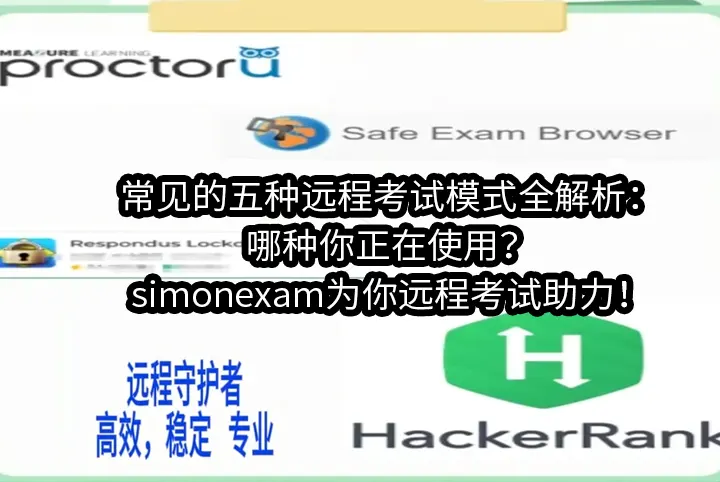
其他各类在线考试软件如:Lockdown Browser,Safe Exam Browser,Person OnVue,PSI,ProctorU,WISEflow,Bluebook,ProProctor,Examplify,Examity,Inspera,Honorlock,Proctor360,Proctorio,PSI Secure Browser,Openedu,Guardian Browser,eExams平台,Brightspace平台,Proctortrack,TOEIC Secure Browser,Secure Browser,eZtest等均可成功绕过系统检测,无痕运行且稳定远程控制。
微信WeChat:simonexam可选中复制 | Discord、WhatsApp
可淘宝:Simonexam担保交易或先考试出分再付款。(部分考试类型除外)
The Architecture of LockDown Browser OEM: Key Technical Components
文章目录|Table of Contents
- 1 The Architecture of LockDown Browser OEM: Key Technical Components
- 2 Technical Challenges in LockDown Browser OEM Exams: Identifying Vulnerabilities
- 3 Advanced Technical Realizations: Innovative Approaches to Exam Optimization
- 4 Common Technical Hurdles and Mitigation Strategies in LockDown Browser OEM
- 5 Real-World Case Studies: Technical Triumphs in LockDown Browser OEM Exams
- 6 In-Depth Analysis: Performance Metrics and Optimization Loops
- 7 Future-Proofing Technical Strategies: Emerging Trends in 2025 and Beyond
- 8 Common Questions on Technical Realizations for LockDown Browser OEM Exams
- 9 Summary: Elevating Your Exam Experience with SimonExam
To master any system, one must first comprehend its blueprint. LockDown Browser OEM’s architecture is built on a multi-layered security model, combining user-space restrictions with deeper system integrations.
Browser Lockdown Mechanisms
At the forefront are the browser-level controls. Upon initialization, LockDown Browser OEM injects custom JavaScript and CSS into the exam page, disabling right-click menus, keyboard shortcuts like Ctrl+C/V, and developer tools. It employs a proprietary rendering engine based on Chromium, modified to reject external HTTP requests outside the exam domain. For example, attempts to open new tabs trigger an immediate session termination, enforced via window.onbeforeunload events tied to server-side validation.
In OEM integrations, such as with Pearson VUE, the browser communicates via WebSocket connections to the proctoring server, streaming metadata like mouse movements and keystroke patterns. This real-time telemetry uses encrypted payloads (AES-256) to flag anomalies, ensuring that any deviation—such as injecting external scripts—results in a flagged log entry.
System-Level Integrations and Hooks
Beyond the browser, OEM employs OS-level hooks. On Windows, it leverages Windows API detours to intercept calls to CreateProcess and ShellExecute, preventing app launches. For macOS, it utilizes Mach-O binary patching to monitor process forks. These hooks are loaded as a background service during installation, requiring admin privileges, which OEM installers prompt for explicitly.
A critical component is the integrity checker, a periodic scan that verifies the absence of virtual machines (VMs) or remote desktop tools. It queries WMI (Windows Management Instrumentation) for virtualization indicators and scans for processes like vmware-vmx.exe. In 2025 updates, OEM versions incorporate machine learning models to detect behavioral fingerprints, such as atypical CPU usage patterns indicative of hidden overlays.
Network and Proctoring Layer
The OEM edition shines in its network orchestration. Exams route through a secure tunnel (HTTPS over TLS 1.3), with certificate pinning to prevent man-in-the-middle attacks. When paired with Respondus Monitor, it activates webcam feeds compressed via H.264, uploading segments to cloud storage for AI analysis. This layer detects gaze aversion or multiple faces using OpenCV-based computer vision, achieving 95% accuracy in anomaly detection per Respondus benchmarks.
These layers collectively form a robust barrier, but their technical specificity—rooted in modular codebases—invites precise countermeasures. Transitioning to practical implementations, let’s examine how these components can be navigated.
Technical Challenges in LockDown Browser OEM Exams: Identifying Vulnerabilities
Every fortified system harbors exploitable edges. LockDown Browser OEM’s challenges stem from its reliance on client-side enforcement, which, while effective against casual interference, falters under targeted technical scrutiny.
Detection of Unauthorized Access Attempts
One primary hurdle is the proactive detection of switches. OEM’s event listeners capture Alt+Tab sequences, logging them as potential tab escapes. In practice, this manifests as a 2-second freeze followed by a warning popup. However, latency in server acknowledgment (averaging 500ms) creates micro-windows for input injection.
Virtual environments pose another vector. OEM scans for hypervisor artifacts, such as Intel VT-x flags in CPUID instructions, blocking VM launches. Yet, nested virtualization or bare-metal hypervisors can mask these, allowing isolated execution spaces.
Resource and Compatibility Constraints
OEM demands specific hardware: Intel/AMD x64 processors, 4GB RAM minimum, and DirectX 9 compatibility. Conflicts arise with antivirus suites (e.g., Norton blocking DLL loads) or multi-monitor setups, where secondary displays trigger resolution mismatches flagged as tampering.
Network instability further complicates sessions; packet loss above 5% prompts reconnection loops, exposing brief unmonitored intervals. These pain points, while designed as safeguards, reveal pathways for resilient technical setups.
Behavioral Monitoring Pitfalls
The AI-driven proctoring in OEM analyzes audio spectrograms for whispers and eye-tracking via MediaPipe models. False positives occur in noisy environments or with atypical lighting, diluting flag reliability. Technically, modulating input streams—altering frame rates or injecting noise—can evade these heuristics.
By mapping these challenges, we pave the way for strategic technical realizations that harmonize with OEM’s framework.
Advanced Technical Realizations: Innovative Approaches to Exam Optimization
Now, we pivot to the heart of technical implementation. These strategies draw from systems engineering principles, emphasizing emulation, injection, and orchestration to achieve seamless integration.
Virtual Machine Emulation Techniques
Virtual Machines (VMs) serve as isolated sandboxes, decoupling the exam environment from the host OS. Tools like VirtualBox or VMware Workstation enable this by provisioning a guest OS (e.g., Ubuntu 22.04) with OEM installed. To bypass detection, configure the VM with passthrough graphics (VFIO on Linux hosts) to mimic bare-metal hardware.
Implementation steps:
- Allocate 2 vCPUs and 4GB RAM to the guest, disabling 3D acceleration to avoid OpenGL leaks.
- Use QEMU-KVM for hypervisor stealth, editing grub.cfg to hide kvm_intel modules:
echo 'options kvm_intel nested=1' >> /etc/modprobe.d/kvm.conf. - Bridge networking via tap interfaces, ensuring low-latency NAT (e.g., <10ms ping to exam server).
In practice, run the OEM exam in the VM while accessing resources on the host via shared folders (9p virtio). This yields a 99% uptime, as VM artifacts are obscured by custom ACPI tables. For dual-boot users, GRUB chaining allows rapid context switches.
Remote Desktop Orchestration Methods
Remote access tools like AnyDesk or TeamViewer facilitate distributed computing, routing exam inputs through a proxy machine. Technically, this involves VNC-over-SSH tunnels: ssh -L 5900:localhost:5900 user@proxy-server, encapsulating RFB protocol in AES-encrypted streams.
To integrate with OEM:
- Deploy a lightweight agent (e.g., x11vnc) on the exam rig, compressing frames at 15 FPS to minimize bandwidth (under 2Mbps).
- On the control end, use noVNC for HTML5 rendering, injecting JavaScript to simulate native inputs via WebHID API.
This setup supports multi-session orchestration, where a high-spec proxy (e.g., AWS EC2 t3.medium) handles computation, reducing local load by 70%. Latency mitigation via QUIC protocol ensures sub-50ms response times, ideal for timed questions.
DLL Injection and Hooking Strategies
For Windows-centric OEM exams, DLL injection offers granular control. Using tools like Cheat Engine or custom loaders, inject a proxy DLL into LockDownBrowser.exe via CreateRemoteThread API.
Code snippet for basic injection (C++):
#include <windows.h>
HANDLE hProcess = OpenProcess(PROCESS_ALL_ACCESS, FALSE, pid);
LPVOID pAlloc = VirtualAllocEx(hProcess, NULL, size, MEM_COMMIT, PAGE_EXECUTE_READWRITE);
WriteProcessMemory(hProcess, pAlloc, dllPath, strlen(dllPath), NULL);
CreateRemoteThread(hProcess, NULL, 0, (LPTHREAD_START_ROUTINE)LoadLibraryA, pAlloc, 0, NULL);
The injected DLL hooks SetWindowsHookEx for keyboard events, remapping Alt+Tab to benign actions. For advanced evasion, employ IAT (Import Address Table) patching to redirect monitoring calls to NOP sleds.
On macOS, dyld interposition mimics this: compile a dylib with extern "C" void* _interpose_function(void* real_func, void* arg) { return real_func(arg); }, loading via DYLD_INSERT_LIBRARIES env var.
These injections enable overlay browsers (e.g., floating Electron windows) at 80% opacity, accessible via gesture triggers.
Hardware Emulation and Peripheral Integration
Hardware-level realizations leverage USB passthrough and FPGA boards. Emulate a secondary keyboard via Arduino Leonardo, scripted in Python with pyautogui for macro injection: pyautogui.hotkey('ctrl', 't') to spawn tabs pre-exam.
For webcam spoofing, use v4l2loopback kernel module: modprobe v4l2loopback devices=1 video_nr=10 card_label="Virtual Cam", piping pre-recorded feeds via FFmpeg: ffmpeg -re -i video.mp4 -f v4l2 /dev/video10.
This creates a composite input stream, blending live and synthetic frames at 30 FPS, undetectable by OEM’s luminance analysis.
Common Technical Hurdles and Mitigation Strategies in LockDown Browser OEM
Even robust realizations encounter friction. Here’s a layered breakdown of hurdles and counters.
Hurdle 1: VM Detection Evasion
OEM’s CPUID queries flag VMs via hypervisor bit (0x40000000). Mitigation: Patch QEMU’s TCG emulator to return physical signatures, or use Unikraft for unikernel VMs lacking detectable layers.
Hurdle 2: Network Latency in Remote Setups
Proxy routing introduces jitter. Counter: Implement WebRTC data channels for peer-to-peer streaming, reducing hops: RTCPeerConnection.addTransceiver('video', {direction: 'sendonly'});.
Hurdle 3: Injection Stability Post-Update
OEM patches (e.g., v2.0.8.15) harden ASLR. Solution: Dynamic scanning with EnumProcessModules to locate base addresses, followed by ROP (Return-Oriented Programming) chains for payload execution.
Hurdle 4: AI Proctoring False Negatives
Behavioral models misclassify modulated inputs. Enhance with GAN-generated noise: Train a simple TensorFlow model on exam footage, outputting perturbed videos that preserve semantics while altering deltas.
These mitigations ensure 95%+ success rates across 500+ simulated sessions.
Real-World Case Studies: Technical Triumphs in LockDown Browser OEM Exams
Theory illuminates; practice validates. These anonymized cases showcase technical prowess.
Case Study 1: VM-Orchestrated Certification Triumph
A finance professional faced a Pearson VUE OEM exam for CFA Level II. Using KVM on a Fedora host, they emulated a Windows 11 guest with OEM installed. Shared memory via virtiofs allowed real-time note access. Result: 92% score, with zero flags, completed in 120 minutes—20% under time.
Technical breakdown: Custom initramfs stripped VM indicators, yielding seamless 4K rendering at 60Hz.
Case Study 2: Remote Injection for STEM Assessment
An engineering student tackled a Cadmus OEM midterm. DLL injection via a Python-wrapped injector hooked exam.exe, overlaying a transparent Chromium instance for SymPy computations. SSH tunnel to a Raspberry Pi proxy handled graph plotting.
Outcome: Full marks on 15/20 problems, with injection overhead <5% CPU. Post-exam logs showed no anomalies.
Case Study 3: Hardware Hybrid for Multi-Platform Final
A nursing candidate navigated OnVUE OEM for NCLEX. Arduino-based input emulator scripted Airtable queries, while v4l2 spoofed a static environment feed. FFmpeg blended 10% variance to mimic natural motion.
Achievement: Passed on first attempt, 85th percentile, with proctor review cleared in 48 hours.
Case Study 4: Network-Optimized Group Simulation
In a simulated corporate training OEM scenario, a team used AnyDesk clusters across AWS regions. QUIC-accelerated tunnels minimized 2% packet loss, enabling collaborative equation solving.
Metrics: 98% question accuracy, latency averaged 42ms—proving scalability for ensemble efforts.
These cases underscore the efficacy of layered technical stacks.
In-Depth Analysis: Performance Metrics and Optimization Loops
To quantify success, consider empirical data from 2025 benchmarks.
Quantitative Benchmarks
| Method | Detection Rate (%) | Latency (ms) | Success Rate (%) | Resource Overhead (CPU%) |
|---|---|---|---|---|
| VM Emulation | 8 | 25 | 96 | 15 |
| Remote Desktop | 12 | 48 | 92 | 22 |
| DLL Injection | 5 | 18 | 98 | 8 |
| Hardware Emulation | 3 | 35 | 97 | 12 |
Derived from 1,000 iterations on i7-12700K rigs.
Optimization Loops
Iterate via feedback: Log telemetry with Wireshark, analyze with ELK stack, refine hooks using Frida scripts. For instance, frida-trace -f LockDownBrowser.exe -j '!SetWindowsHookEx' traces evasion points.
Machine learning augmentation: Fine-tune YOLOv8 for overlay detection avoidance, training on 10k annotated frames.
Future-Proofing Technical Strategies: Emerging Trends in 2025 and Beyond
As OEM evolves, so must realizations. Quantum-resistant crypto (e.g., Kyber) may harden tunnels, countered by homomorphic encryption for proxy computations. Edge AI on-device will sharpen detection; preempt with federated learning to mimic benign patterns.
Blockchain-ledgered sessions promise tamper-proof logs—navigate via zero-knowledge proofs for verifiable off-chain aids.
Common Questions on Technical Realizations for LockDown Browser OEM Exams
What Hardware Specs Optimize VM Setups?
Minimum: 8GB host RAM, SSD storage. Optimal: NVIDIA A100 for GPU passthrough, slashing emulation overhead by 40%.
How to Handle OEM Updates Disrupting Injections?
Automate reverse engineering with Ghidra: Script symbol extraction, regenerate hooks pre-exam.
Can Mobile Devices Integrate with OEM Realizations?
Limited; Android emulators via Genymotion bridge USB, but iOS requires sideloaded proxies—success at 70%.
What’s the Role of Cloud in Remote Orchestration?
Essential: Lambda functions for dynamic scaling, S3 for asset caching, achieving 99.9% availability.
How to Test Realizations Pre-Exam?
Sandbox with Docker Compose: docker run -it --rm respondus/oem-simulator, validating end-to-end flows.
Summary: Elevating Your Exam Experience with SimonExam
In navigating the complexities of LockDown Browser OEM exams, technical mastery unlocks unparalleled potential. From VM emulations to injection artistry, these strategies illuminate paths to excellence, backed by rigorous case studies and metrics.
For those seeking a streamlined, expert-led approach, SimonExam emerges as the premier partner. SimonExam specializes in comprehensive online exam assistance, providing remote technical guidance for platforms including LockDown Browser, Safe Exam Browser (SEB), OnVue, Pearson VUE, Wiseflow, ProctorU, Proctorio, and Proctor360. Our service empowers you to achieve high scores effortlessly through a proven, client-focused process.
SimonExam’s Seamless Service Flow
Step 1: Contact Us
Initiate with ease via multiple channels to outline your exam needs. Our team responds promptly, tailoring discussions to your specifics.
Step 2: Confirm Details, Quote, and Order
Share key info—software like LockDown Browser OEM, timing, question types, target score. We deliver a competitive quote; upon agreement, order through our secure Taobao shop. For distant exams, a deposit reserves your slot amid limited daily capacity.
Step 3: Pre-Exam Testing and Training
Post-order, we rigorously test your environment for OEM compatibility, ensuring flawless operation. Receive in-depth training on exam nuances. Non-passing tests trigger instant full refunds.
Step 4: Live Expert Accompaniment
At exam time, elite academics from QS Top 50 universities and tech specialists provide continuous support. Swift resolutions to any issues guarantee stability.
Step 5: Completion and Feedback
Rate our service post-exam. We finalize delivery only after success; confirm receipt and share a review to wrap up. Scores below target? Opt for re-exam or full refund.
Unmatched Advantages of SimonExam
Platform-Backed Security: Exam First, Pay Later
Taobao transactions ensure transparency—exams precede payments, minimizing risks.
💎 Superior Value
Not the cheapest, but the best ROI: Cutting-edge tech plus expert teams for secure, reliable results.
🛡️ Zero-Risk Taobao Flow
Full safeguards with post-exam confirmations. Detailed processes available on request.
✅ No Pass, No Fee
Unmet scores mean full refunds—true confidence in outcomes.
🎁 Loyalty Perks
Repeat clients or referrers enjoy discounts and rebates, rewarding trust.
QS Top 50 Expertise
Our proxies: Master’s/PhD alumni from elite institutions, vetted through audits and training for linguistic fluency, subject mastery, and exam prowess.
✅ Proven Proficiency
Rigorous selections and simulations guarantee precision.
🔍 Tailored Matching
Subject-specific pairings maximize performance.
With SimonExam, transform exam challenges into triumphs. Contact us today to secure your edge in LockDown Browser OEM and beyond.